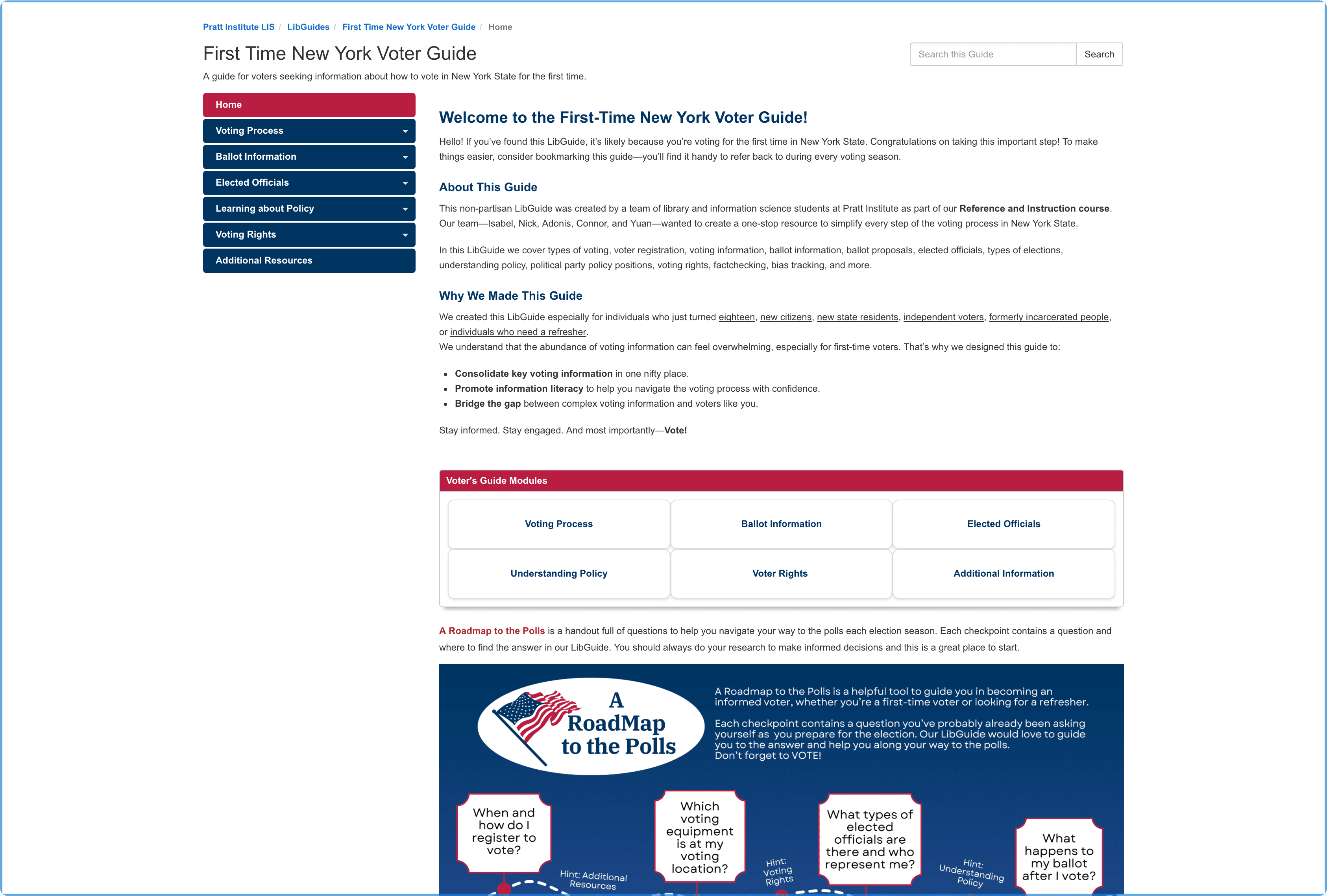
First-Time New York Voter Guide
First-Time New York Voter Guide
Date
Fall 2024
Fall 2024
Professor
Project Link
LibGuide
Project Description
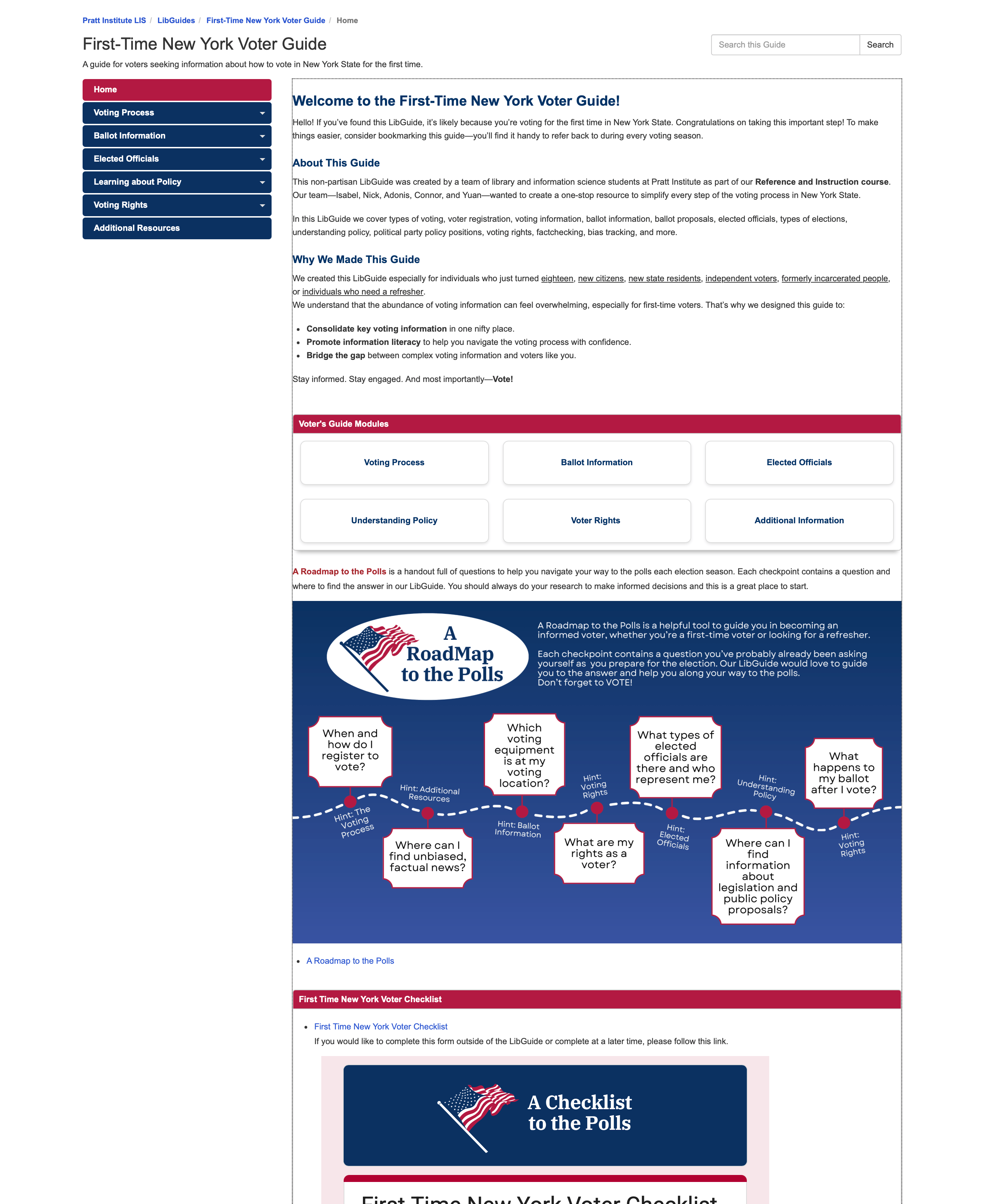
As part of INFO-652: Reference and Instruction, our group developed a LibGuide to assist first-time voters in New York State. The guide consolidates essential voting information, promotes information literacy, and makes complex procedures more accessible for new voters.
Methods
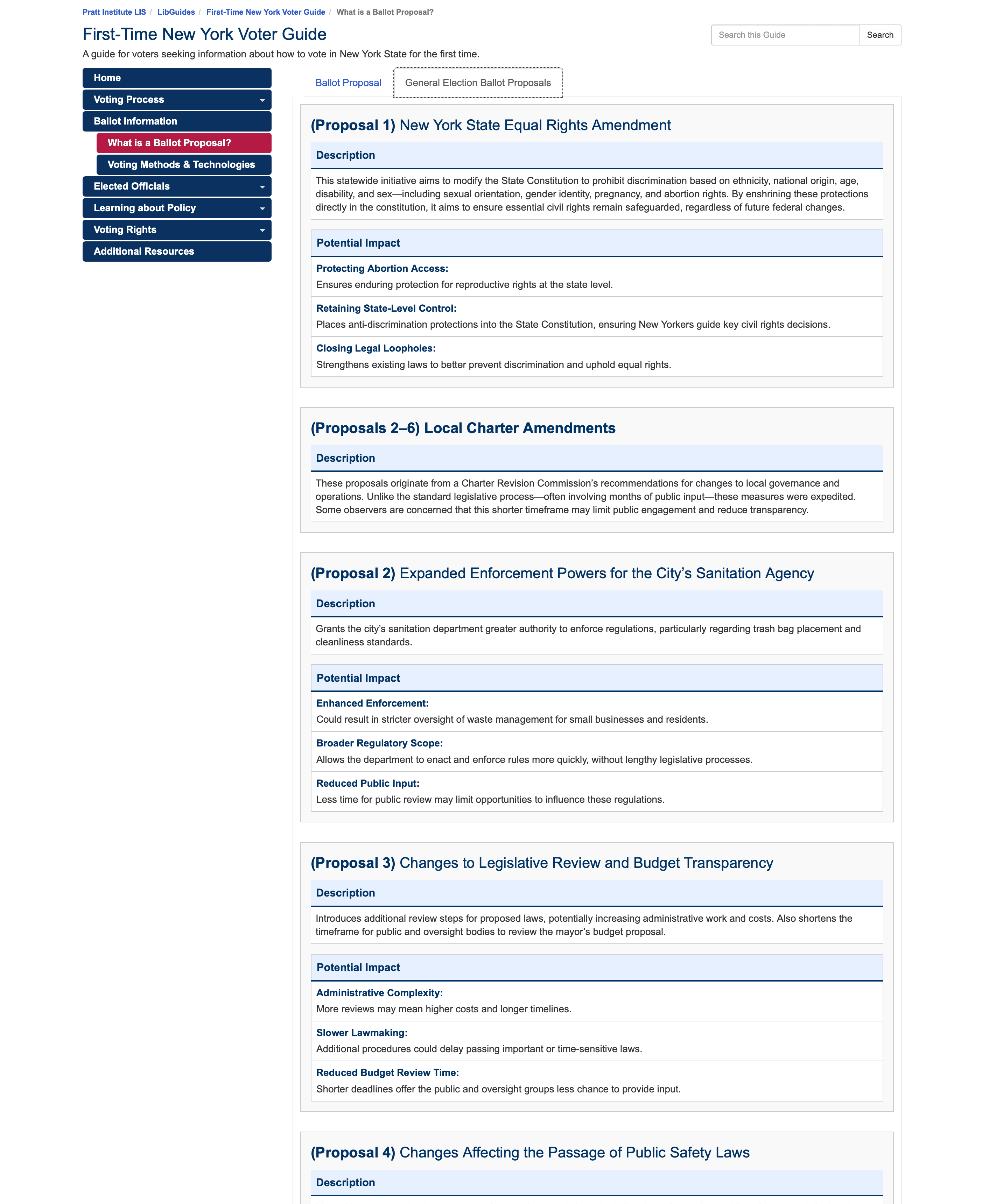
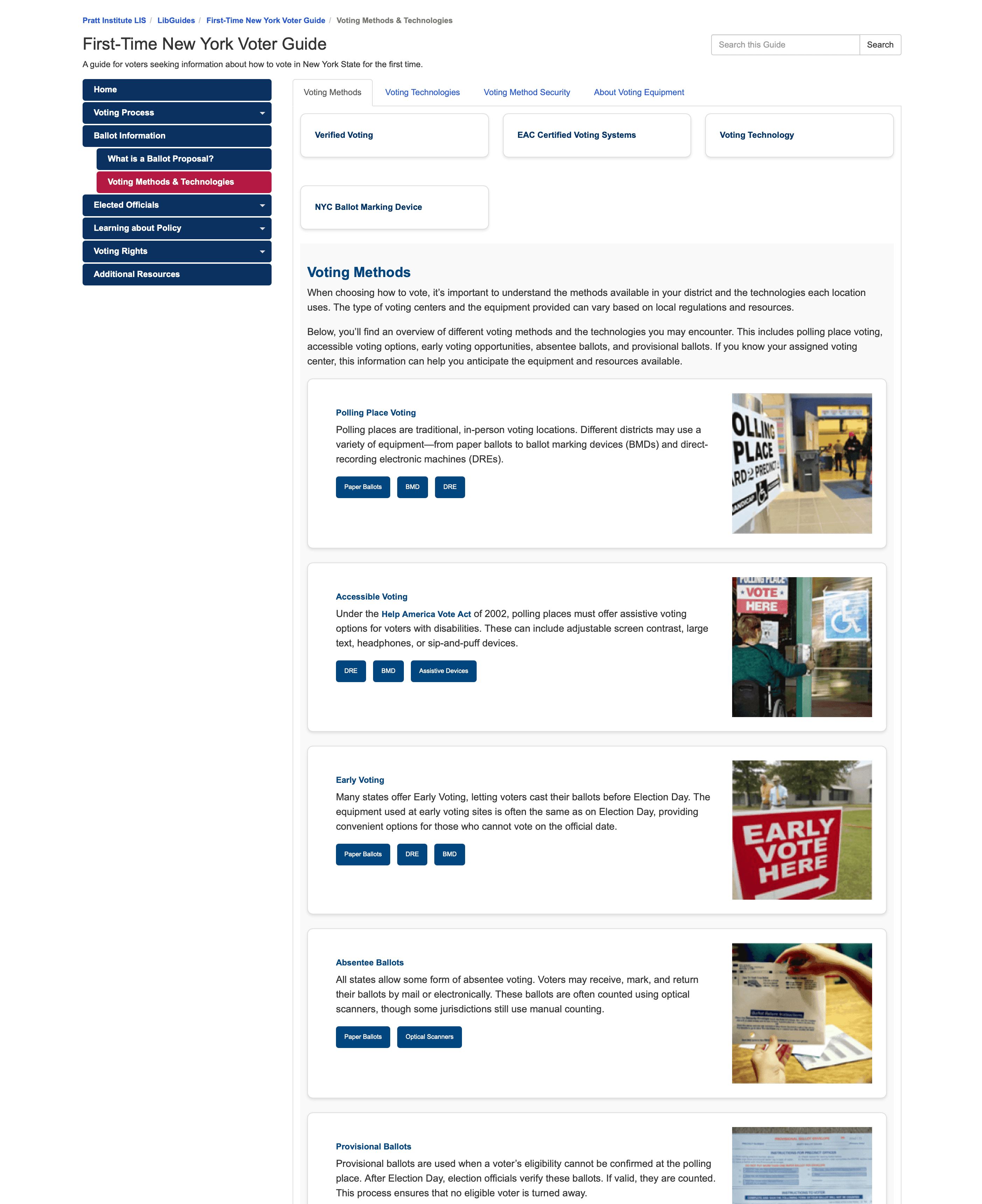
The process began with researching voting challenges related to understanding ballot proposals and different voting technologies. My research showed existing resources often use complex language, limiting comprehension. I aimed to simplify the material, analyzing current content and presenting key concepts in clear, accessible language suitable for a LibGuide.
Role & Contributions
This was a collaborative project with Nick Brenner, Isabel Brandt, Yuan Sciscent, and Connor O'Brien. My primary contribution involved developing the Ballot Information section of the LibGuide. Additionally, I helped ensure users could engage with the guide intuitively, making the complex information about the voting system and its technologies more accessible and digestible for a general audience.
Learning Outcome
Ethical/Creative/Critical Practice
Rationale
This was my first time working on a LibGuide, and I hadn't realized how important these guides can be for making information more accessible. At first, I was surprised by just how much impact a LibGuide can have in breaking down complex topics and supporting people who might feel overwhelmed by the voting process. Even with the platform’s limitations, we managed to create a comprehensive and approachable resource. This project taught me a lot about how to simplify information and make sure it truly reaches those who need it most. It also helped me recognize how important resources like this guide are for supporting information literacy and making it easier for users to navigate the complex world of voting.
Gallery
Project Description
As part of INFO-652: Reference and Instruction, our group developed a LibGuide to assist first-time voters in New York State. The guide consolidates essential voting information, promotes information literacy, and makes complex procedures more accessible for new voters.
Methods
The process began with researching voting challenges related to understanding ballot proposals and different voting technologies. My research showed existing resources often use complex language, limiting comprehension. I aimed to simplify the material, analyzing current content and presenting key concepts in clear, accessible language suitable for a LibGuide.
Role & Contributions
This was a collaborative project with Nick Brenner, Isabel Brandt, Yuan Sciscent, and Connor O'Brien. My primary contribution involved developing the Ballot Information section of the LibGuide. Additionally, I helped ensure users could engage with the guide intuitively, making the complex information about the voting system and its technologies more accessible and digestible for a general audience.
Learning Outcome
Ethical/Creative/Critical Practice
Rationale
This was my first time working on a LibGuide, and I hadn't realized how important these guides can be for making information more accessible. At first, I was surprised by just how much impact a LibGuide can have in breaking down complex topics and supporting people who might feel overwhelmed by the voting process. Even with the platform’s limitations, we managed to create a comprehensive and approachable resource. This project taught me a lot about how to simplify information and make sure it truly reaches those who need it most. It also helped me recognize how important resources like this guide are for supporting information literacy and making it easier for users to navigate the complex world of voting.
Gallery